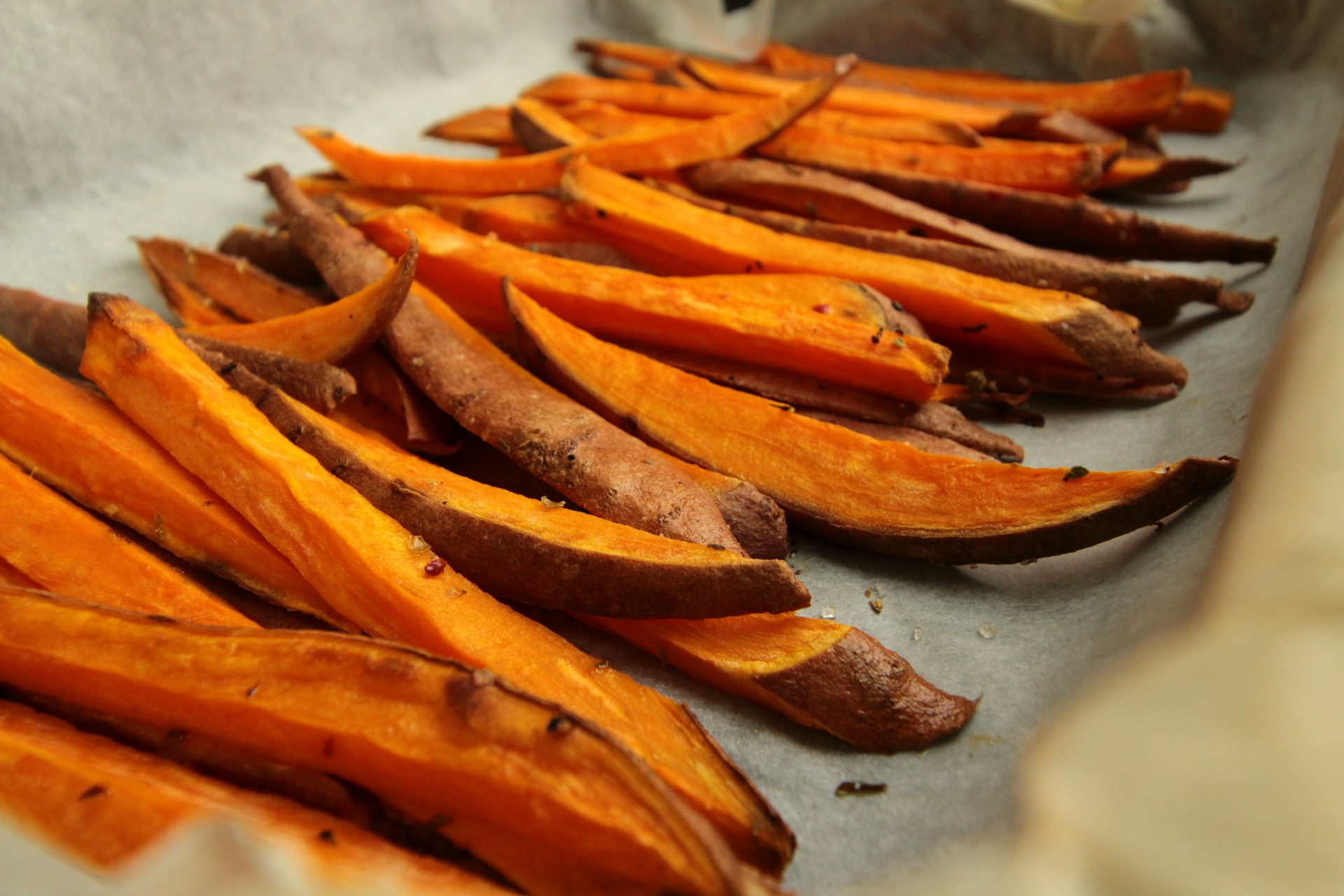
- Bake medium whole sweet potatoes at 400°F/200°C for about 45–60 minutes.
- Wash and dry the potatoes thoroughly, then pierce each one several times with a fork.
- Leave them unwrapped for drier skin and better caramelization.
- Choose potatoes with a similar thickness when baking several at once.
- Test the thickest part with a thin knife or fork; a fully baked potato should offer almost no resistance.
Learning how to bake sweet potatoes in the oven is simple: wash them, pierce the skin, and bake them uncovered at 400°F/200°C until completely tender.
A medium sweet potato usually takes 45–60 minutes, but size and thickness matter more than the clock. A small, narrow potato may be ready in about 35 minutes, while an extra-large potato can take 75 minutes or longer.
Use the cooking time as a guide for when to start checking. The sweet potato is ready when a thin knife, fork, or skewer passes through the thickest part with almost no resistance.
What Is the Best Temperature for Baking Sweet Potatoes?
For most home cooks, 400°F/200°C is the best temperature for whole baked sweet potatoes. It provides a good balance of cooking speed, even tenderness, and exterior browning.
At this temperature, medium sweet potatoes generally take 45–60 minutes. This is also the temperature and time range recommended by the North Carolina Sweetpotato Commission for simple whole baked sweet potatoes.
You can use other temperatures when necessary:
- At 375°F/190°C, medium potatoes usually take about 55–70 minutes.
- At 425°F/220°C, medium potatoes may be ready in about 40–50 minutes and can develop a darker exterior.
Use 400°F when the sweet potatoes are baking by themselves and there is no reason to match the temperature of another dish.
What You Need
The only essential ingredient is the sweet potato. Oil and salt are optional.
You will also need a rimmed baking sheet, a fork, a clean towel or paper towel, and a thin knife or skewer for checking doneness. Parchment paper or aluminum foil makes cleanup easier by catching the sticky liquid that sometimes escapes during baking.
A rimmed sheet is preferable to a flat cookie sheet because its raised edge helps prevent drips from reaching the oven floor.
How to Choose Sweet Potatoes for Baking
Choose sweet potatoes that feel firm and heavy for their size. Avoid potatoes with mold, leaking liquid, unpleasant odors, deep cuts, or large soft areas.
Minor surface scratches are usually harmless. A small damaged spot can be trimmed away when the remainder of the potato is firm and sound.
When baking several potatoes, choose ones with a similar thickness. Thickness affects cooking time more than length because heat must travel from the outside to the center.
Orange-fleshed varieties generally become soft and moist when baked. White- and purple-fleshed varieties may remain denser or starchier even when fully cooked.
Store raw sweet potatoes in a cool, dry, dark, well-ventilated place. Do not refrigerate them unless no suitable alternative is available, because low temperatures can damage their texture and flavor.
How to Prepare Sweet Potatoes Safely
Wash your hands before handling the potatoes.
Rinse each sweet potato under running water and gently rub the entire surface. Use a clean produce brush to remove dirt from grooves and uneven areas.
Do not wash sweet potatoes with soap, detergent, bleach, or commercial produce wash. The FDA recommends washing produce under plain running water and drying it with a clean cloth or paper towel.
Dry the potatoes thoroughly. Surface water creates steam and delays browning.
There is no need to peel them. The skin helps retain moisture and hold the potato together, and it is edible when properly washed and cooked.
Pierce each potato five or six times with a fork, distributing the holes around the top, bottom, and sides. Piercing provides openings through which steam can escape.
How to Bake Sweet Potatoes Step by Step
- Preheat the oven.
Set the oven to 400°F/200°C and place a rack near the center. - Prepare the baking sheet.
Line a rimmed sheet with parchment paper or aluminum foil. This is optional but makes cleanup easier. - Wash, dry, and pierce the potatoes.
Clean the potatoes under running water, dry them thoroughly, and pierce each one several times with a fork. - Add oil and salt if desired.
When you plan to eat the skin, rub each potato with a very thin coating of olive oil or neutral cooking oil and add a light sprinkle of salt. Skip this step when you do not plan to eat the skin. - Arrange the potatoes.
Place them in a single layer with about 1 inch/2.5 cm of space between them. Do not stack them or cover the dish. - Bake until tender.
Bake medium potatoes for approximately 45–60 minutes. Begin checking small potatoes after about 35 minutes and large potatoes after about 55 minutes. - Test the center.
Insert a thin knife, fork, or skewer into the thickest part. If you feel a firm center, continue baking for another 5–10 minutes before testing again. - Rest and open.
Let the potatoes rest for about 5 minutes. Cut a line lengthwise across the top, press the ends gently toward the center, and fluff the flesh with a fork.
Whole sweet potatoes do not normally need to be turned. Rotate the baking sheet if your oven has a strong hot spot or one side is browning noticeably faster.
How Long to Bake Sweet Potatoes
The following times are estimates. Potato shape, variety, starting temperature, oven calibration, and airflow can all affect the final cooking time.
| Sweet potato size | Approximate weight | 375°F/190°C | 400°F/200°C | 425°F/220°C |
| Small | 5–8 oz/140–225 g | 45–55 minutes | 35–45 minutes | 30–40 minutes |
| Medium | 8–12 oz/225–340 g | 55–70 minutes | 45–60 minutes | 40–50 minutes |
| Large | 12–16 oz/340–450 g | 70–85 minutes | 60–75 minutes | 50–65 minutes |
| Extra large | More than 16 oz/450 g | 85–100 minutes | 75–90 minutes | 65–80 minutes |
A thick, rounded potato may need more time than a long, narrow potato of the same weight.
When baking different sizes together, test the smallest potato first. Remove each one as soon as it becomes tender and leave the larger potatoes in the oven.
If recipes regularly cook faster or slower than expected in your oven, use an oven thermometer to check its actual temperature.
How to Tell When a Sweet Potato Is Done
Tenderness through the center is the most reliable indication of doneness.
Insert a thin knife, fork, or metal skewer into the thickest part. It should pass through easily without stopping at a firm core.
The skin may look wrinkled, loosened, or slightly puffed. Sticky liquid may appear around the fork holes or ends. This is normal; moisture and natural sugars sometimes escape and caramelize on the hot pan.
You can also squeeze the potato gently while wearing an oven mitt. It should yield under light pressure. Never squeeze it with an unprotected hand because the skin and escaping steam can cause burns.
If the center is still firm after you cut the potato open, close it as much as possible and return it to the oven for another 10 minutes.
Should You Wrap Sweet Potatoes in Foil?
You do not need to wrap sweet potatoes in foil.
Leaving them uncovered allows moisture to escape, producing drier skin and more noticeable caramelization. Foil traps steam against the surface, which creates softer, wetter skin.
The North Carolina Sweetpotato Commission also notes that sweet potatoes caramelize better when they are not wrapped in foil.
You may still line the baking sheet with foil. Lining the pan catches drips without trapping steam around the individual potatoes.
How to Improve the Skin and Caramelization
Dry the potatoes thoroughly after washing. Any surface water must evaporate before browning can begin.
Leave the potatoes unwrapped and avoid crowding the baking sheet. Space allows moisture to escape.
For more flavorful skin, apply a very thin coating of oil and a light sprinkle of salt. Too much oil can make the pan greasy rather than improving the texture.
Baking at 425°F/220°C can produce a darker exterior, especially on small and medium potatoes. Begin checking early because sugary drips may darken quickly.
How to Bake Sweet Potatoes Faster
For a faster method, cut the potatoes in half lengthwise.
Heat the oven to 425°F/220°C. Rub a small amount of oil over the cut surfaces and place the halves cut-side down on a parchment-lined baking sheet.
Bake for approximately 25–35 minutes, depending on their thickness. They are ready when a fork passes through easily and the cut surfaces are browned.
Halved potatoes lose more moisture and brown more strongly on one side, so they do not have exactly the same texture as whole baked sweet potatoes.
You can also combine the microwave and oven. Pierce a medium potato and microwave it in short intervals, turning it occasionally, until it begins to soften. Transfer it to a 425°F/220°C oven for about 10–15 minutes to finish cooking and dry the skin.
Microwave power varies, so monitor the potato rather than relying on one fixed microwave time.
How to Bake Several Sweet Potatoes at Once
Several sweet potatoes can bake in approximately the same time as one or two when they are arranged in an uncrowded single layer.
Choose potatoes with similar thicknesses and test each one individually. Remove smaller potatoes as soon as they become tender.
When using two baking sheets, place one in the upper third and the other in the lower third of the oven. Halfway through baking, switch their positions and rotate both sheets from front to back.
Two full trays may need an additional 5–15 minutes because the oven is more heavily loaded and heat escapes when the sheets are moved.
Common Problems and Solutions
The skin looks done, but the center is hard
The potato needs more time. Reduce the temperature to 375°F or 400°F if the exterior is already very dark, then continue baking for another 10–20 minutes.
The outside is becoming too dark
Move the pan to the center rack and reduce the temperature. A small area can be covered loosely with foil while the center finishes cooking.
Dark syrup on the pan does not necessarily mean the potato itself is burnt. Check the skin and flesh before discarding it.
The skin is wet or soggy
Foil wrapping, crowding, and surface moisture can soften the skin. Remove any wrapper and return the potato to a 425°F oven for several minutes.
For the next batch, dry the potatoes completely and leave more space around them.
The inside is dry or stringy
Some varieties are naturally starchier than others. Age and overcooking can also produce a dry texture.
Add butter, olive oil, yogurt, tahini, or another moist topping. For a softer result next time, choose firm orange-fleshed potatoes and begin testing them earlier.
The potatoes are cooking unevenly
Different thicknesses and oven hot spots are the most common causes. Rotate the pan and check every potato separately instead of waiting for the entire batch to finish at once.
How to Serve Baked Sweet Potatoes
For a simple side dish, add butter or olive oil, salt, and black pepper.
For a savory version, try Greek yogurt, sour cream, grated cheese, chives, green onions, garlic powder, smoked paprika, or chili flakes.
For a sweeter version, add butter and cinnamon. A small amount of maple syrup, honey, toasted pecans, walnuts, or plain yogurt also works.
To turn a baked sweet potato into a full meal, combine it with a protein, a sauce, and a fresh or crunchy topping. Good combinations include black beans with salsa and avocado, chickpeas with tahini and herbs, shredded chicken with yogurt sauce, lentils with sautéed vegetables, or chili with grated cheese.
The cooked flesh can also be used in soup, mashed sweet potatoes, pancakes, muffins, quesadillas, hummus, or pasta sauce.
How to Store and Reheat Baked Sweet Potatoes
Refrigerate cooked sweet potatoes within two hours. Place them in a covered container and keep the refrigerator at 40°F/4°C or below.
Use refrigerated leftovers within three to four days. Reheat only the portion you plan to eat, and heat leftovers to 165°F/74°C.
To reheat a whole sweet potato in the oven, place it on a baking sheet and warm it at 350°F/175°C for approximately 15–25 minutes.
For faster reheating, split it and microwave it on a microwave-safe plate in short intervals until hot in the center. Microwave reheating is convenient but will soften the skin.
For longer storage, freeze the cooked flesh in an airtight freezer-safe container. The skin usually becomes soft after freezing and thawing, so freezing the flesh alone generally gives a better result.
Frequently Asked Questions
Can I bake sweet potatoes ahead of time?
Yes. Bake them, refrigerate them within two hours, and store them in a covered container for up to three to four days. Reheat only the amount you plan to eat.
Can I bake sweet potatoes directly on the oven rack?
Yes. Direct-rack baking exposes more of the skin to hot air. Place a rimmed, lined baking sheet on the rack below to catch sticky drips.
How should I bake sweet potatoes in a convection or fan oven?
Fan ovens may cook the potatoes more quickly. Follow the oven manufacturer’s temperature guidance and begin checking approximately 5–10 minutes earlier than you would in a conventional oven.
Why is sticky syrup leaking from the potato?
Moisture and natural sugars can escape through the fork holes or small cracks. The liquid may darken or caramelize on the pan. This is normal.
Why is my baked sweet potato dry or stringy?
The potato may be a naturally starchier variety, or it may be old or overcooked. Orange-fleshed varieties often produce a softer and moister result than many white- or purple-fleshed varieties.
Are sweet potatoes and yams the same?
No. Sweet potatoes and true yams are botanically different. In many United States supermarkets, however, orange-fleshed sweet potatoes are informally labeled as “yams.” This baking method is intended for common supermarket sweet potatoes.