Key Takeaways
- Flatten chicken breasts to an even thickness of about 3/4 inch so the thin ends do not overcook.
- Bake them in a fully preheated conventional oven at 425°F, or 220°C. Use about 400°F, or 200°C, in a fan-assisted oven.
- Coat the chicken lightly with oil and season the top, bottom, and sides.
- Begin checking 3/4-inch-thick breasts after about 16 minutes, but use thickness and temperature rather than time alone.
- Cook each breast to 165°F, or 74°C, in its thickest part, then rest it for five minutes before slicing.
Baked chicken breast can be juicy, tender, and flavorful, but lean meat becomes dry quickly when it cooks unevenly or remains in the oven too long.
For this method, flatten the chicken to a consistent thickness, season it on all sides, and bake it at 425°F. Most breasts that are approximately 3/4 inch thick will take about 16 to 22 minutes, although ovens and individual pieces vary.
A food thermometer provides the most dependable result. The USDA recommends cooking poultry to a minimum internal temperature of 165°F, measured in the thickest part.
This chicken can be served as a main course or used in salads, sandwiches, pasta, wraps, rice bowls, and meal-prep dishes.
Preparation time: About 10 minutes
Cooking time: Approximately 16 to 25 minutes
Resting time: 5 minutes
Servings: 4
What Temperature Should You Use to Bake Chicken Breast?
For this method, 425°F, or approximately 220°C, is a reliable temperature for boneless, skinless chicken breast.
Chicken breast contains relatively little fat. Cooking it in a hotter oven shortens its total exposure to heat and helps the seasoning brown. However, high heat will not prevent dryness if the chicken remains in the oven after it has reached the correct internal temperature.
You can also bake chicken breast at 400°F, but it will generally take several minutes longer. Lower temperatures can work, but they extend the cooking time and may produce less browning.
For a convection or fan-assisted oven, use approximately 400°F, or 200°C, and begin checking the chicken a few minutes earlier.
Always preheat the oven fully before adding the chicken. Starting with a partially heated oven makes the cooking time less predictable.
Ingredients and Equipment
Ingredients
- 4 boneless, skinless chicken breasts, preferably 5 to 7 ounces each
- 1 tablespoon olive oil
- 1 teaspoon paprika
- 1 teaspoon garlic powder
- 1/2 teaspoon onion powder
- 1/2 teaspoon dried oregano or thyme
- 1 teaspoon kosher salt, or about 3/4 teaspoon fine salt
- 1/4 teaspoon ground black pepper
- 1 teaspoon brown sugar, optional
Brown sugar adds mild sweetness and deeper browning, but it is not necessary for juicy chicken.
Equipment
- Rimmed metal baking sheet or shallow baking dish
- Parchment paper
- Meat mallet or rolling pin
- Small bowl
- Instant-read food thermometer
- Clean plate or cutting board
A thermometer is essential because breasts of similar weight can still differ considerably in thickness and cooking time.
How to Prepare Chicken Breast for Baking
Keep raw chicken separate from vegetables, cooked foods, and ingredients that will not be cooked. Wash your hands, utensils, and work surfaces thoroughly after they touch raw poultry.
Do not wash or rinse raw chicken. Washing does not destroy bacteria and can splash contaminated droplets onto nearby surfaces and food. USDA guidance recommends cooking poultry thoroughly rather than rinsing it.
Pat the chicken dry with disposable paper towels, then discard the towels immediately. A dry surface helps the oil and seasoning stick and improves browning.
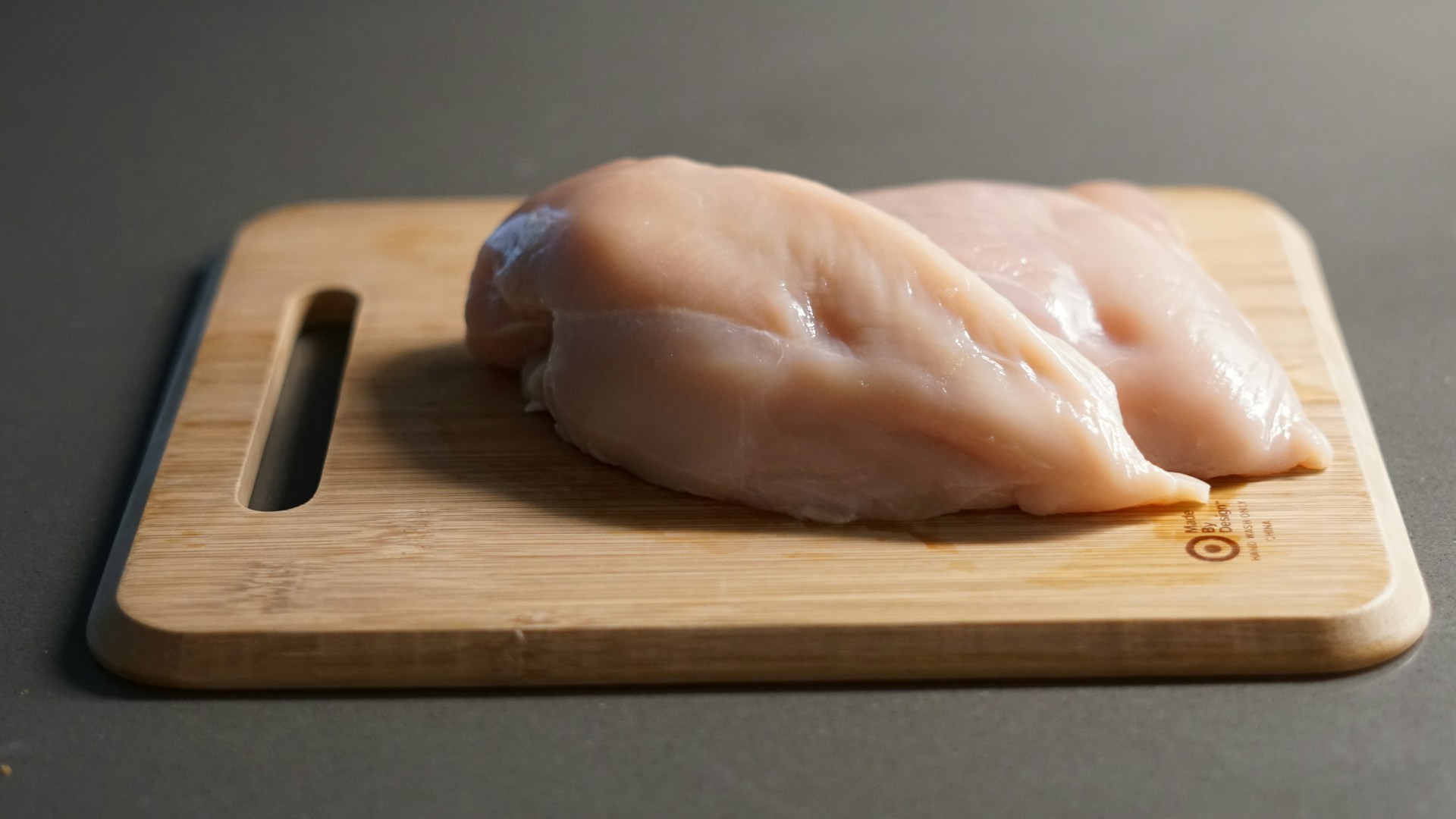
A whole chicken breast is usually thicker at one end than the other. If it is baked in that shape, the thin end may dry out before the center is fully cooked.
Place each breast between two sheets of parchment paper or inside a sturdy food-storage bag. Gently pound the thickest part with a meat mallet or rolling pin.
Aim for an even thickness of approximately 3/4 inch. Avoid pounding so forcefully that the meat tears.
If a breast is unusually large or more than about 1 1/2 inches thick, slice it horizontally into two thinner cutlets before flattening it.
How to Bake Chicken Breast Step by Step
- Preheat the oven.
Heat a conventional oven to 425°F, or 220°C. For a fan-assisted oven, use approximately 400°F, or 200°C. - Prepare the baking sheet.
Line a rimmed metal baking sheet with parchment paper. - Flatten and dry the chicken.
Pat the breasts dry and pound the thickest areas until each piece is close to 3/4 inch thick. - Season the chicken.
Mix the paprika, garlic powder, onion powder, dried herbs, salt, pepper, and optional brown sugar in a small bowl. Rub the chicken with a thin layer of olive oil, then apply the seasoning to the top, bottom, and sides. - Arrange the pieces.
Place the chicken on the prepared sheet with space between the pieces. Do not overlap or tightly crowd them. - Bake and check the temperature.
Place the sheet on the center oven rack. Begin checking 3/4-inch-thick pieces after about 16 minutes. Insert an instant-read thermometer into the thickest part of every breast. - Rest before slicing.
Transfer each breast to a clean plate as soon as it reaches 165°F, or 74°C. Rest for five minutes before slicing.
Never place cooked chicken on a plate or cutting board that held raw poultry unless it has first been thoroughly washed and sanitized.
How Long Does It Take to Bake Chicken Breast at 425°F?
Thickness is generally a better guide than weight. A wide, thin breast may finish before a smaller breast with a thick center.
Use the table as a guide for when the chicken may be ready. The times are estimates, and a thermometer should determine when each piece is done.
| Approximate thickness | Estimated time at 425°F | Guidance |
| 1/2 inch | 12–16 minutes | Begin checking at 12 minutes |
| 3/4 inch | 16–22 minutes | Recommended thickness for this method |
| 1 inch | 20–25 minutes | Check the center carefully |
| More than 1 inch | 25 minutes or longer | Flatten or slice into cutlets when possible |
The chicken’s starting temperature, the accuracy of the oven, the baking pan, and the number of pieces can all affect the cooking time.
Check every breast separately. Remove finished pieces while thicker ones continue cooking.
How Do You Know When Chicken Breast Is Done?
Chicken breast is safely cooked when the center of its thickest part reaches 165°F, or 74°C.
For a thin breast, insert the thermometer through the side and guide the tip toward the center. Do not allow the tip to touch the hot baking sheet because this can produce an inaccurate reading.
The USDA identifies 165°F as the safe minimum internal temperature for poultry and recommends placing the thermometer in the thickest area.
Do not rely only on color, firmness, or clear juices. Safely cooked poultry can occasionally remain slightly pink, and visual appearance cannot confirm that harmful bacteria have been destroyed.
Avoid repeatedly cutting the chicken open during baking. A thermometer is more reliable and causes less loss of moisture.
How to Keep Baked Chicken Breast Juicy
Make the Thickness Even
Even thickness is the most important preparation step. It allows the center and edges to finish cooking at approximately the same time.
Begin Checking Early
Cooking times are estimates. Begin checking near the lower end of the suggested range so that the chicken does not remain in the oven unnecessarily.
Use Only a Thin Layer of Oil
Oil helps seasoning adhere and prevents the surface from becoming leathery. Excess oil can make the seasoning slide off and leave the chicken sitting in liquid.
Season All Sides
Season the top, bottom, and edges. For deeper seasoning, salt the chicken several hours before baking and keep it covered in the refrigerator. Add the oil and remaining spices shortly before cooking.
Rest Before Cutting
Let the chicken rest for five minutes after removing it from the oven. When slicing, cut across the visible grain with a sharp knife to shorten the muscle fibers and make each bite feel more tender.
Common Mistakes When Baking Chicken Breast
The Chicken Is Dry
Overcooking is the most common reason chicken breast becomes dry. Thin pieces can change noticeably with only a few additional minutes in the oven.
Begin checking early and remove each breast when its thickest part reaches 165°F. Do not continue cooking it solely to obtain a darker surface.
Poor browning can result from excess surface moisture, overcrowding, or an oven that was not fully preheated. It does not necessarily mean the center is undercooked.
The Outside Is Cooked but the Center Is Raw
This usually means the breast was too thick or uneven.
Return it to the oven and continue cooking until the center reaches 165°F. For future batches, flatten the thick portion or slice large breasts horizontally into cutlets.
Do not raise the oven temperature significantly. A hotter surface may brown or burn before the center finishes cooking.
The Chicken Releases Too Much Liquid
Some liquid on the baking sheet is normal. A large amount can result from overcrowding, failing to dry the chicken, using a deep dish that traps steam, or cooking previously frozen chicken.
Use a shallow metal sheet pan and leave space around every breast.
The Seasoning Burns
Seasonings containing sugar can darken quickly at high temperatures. Use no more than a small amount of sugar and keep the pan on the center rack.
Paprika and brown sugar naturally turn reddish brown during cooking. Dark seasoning is not necessarily burned, but it should not smell bitter or look black.
The Chicken Tastes Bland
Season the top, bottom, and edges rather than sprinkling spices only on the upper surface.
After baking, add a squeeze of lemon juice, a spoonful of pan juices, or chopped fresh herbs for additional flavor.
Easy Seasoning Variations
Lemon and Herb
Use garlic powder, oregano, thyme, black pepper, and lemon zest. Add fresh lemon juice after baking so that excess liquid does not interfere with browning.
Smoky Paprika
Replace regular paprika with smoked paprika and add a small pinch of cayenne pepper.
Italian-Style
Use garlic powder, dried basil, oregano, salt, and black pepper. Add a small amount of grated Parmesan, but monitor the surface because cheese can brown quickly.
Simple Meal-Prep Seasoning
Use olive oil, salt, black pepper, garlic powder, and paprika. This neutral mixture works well in salads, wraps, pasta, and rice bowls.
Regardless of the seasoning, every breast must reach 165°F in its thickest part.
How to Store and Reheat Baked Chicken Breast
Refrigerate cooked chicken within two hours. If the surrounding temperature is above 90°F, refrigerate it within one hour. Store it in a shallow, airtight container so it cools quickly.
Use refrigerated cooked chicken within three to four days.
When practical, store the breasts whole and slice them shortly before serving. Whole pieces generally lose less moisture than chicken that was sliced before storage.
For longer storage, freeze the chicken in an airtight freezer-safe container or bag. Remove as much excess air as possible. Plain cooked chicken generally maintains its best quality for about four months, although broader government storage charts give a quality range of two to six months for cooked meat and poultry. Food that remains continuously frozen at 0°F, or -18°C, can remain safe longer, but its quality will gradually decline.
To reheat chicken in the oven, place it in a covered baking dish with a small amount of water or broth. Heat it gently until the center reaches 165°F.
For microwave reheating, slice the chicken into evenly sized pieces, add a spoonful of water or broth, and cover it loosely. Heat in short intervals and check that the center reaches 165°F. USDA guidance recommends reheating leftovers to that temperature.
Frequently Asked Questions
Can I season chicken breasts ahead of time?
Yes. You can apply the salt several hours or up to one day before baking. Keep the chicken covered in the refrigerator, then add the oil and remaining spices shortly before cooking.
Can I marinate chicken breast before baking it?
Yes. Marinate the chicken in the refrigerator, not on the countertop. Remove excess marinade before baking if you want better browning.
Discard marinade that has touched raw chicken unless you bring it to a full boil before using it as a sauce.
Can I bake chicken breasts and vegetables on the same pan?
Yes, as long as the vegetables are cut into sizes that will cook in roughly the same amount of time.
Leave space around the chicken so the ingredients roast rather than steam. Check every breast with a thermometer and remove it when it reaches 165°F.
Can I use a glass baking dish?
Yes, but cooking and browning may differ. A shallow metal sheet pan generally allows faster evaporation and better browning than a deep glass or ceramic dish.
Regardless of the pan, rely on the chicken’s internal temperature rather than the stated cooking time alone.
How can I keep meal-prep chicken from drying out?
Store the breasts whole when possible and slice them shortly before serving. Save a small amount of the cooking juices and add them to the container.
Reheat the chicken gently with a spoonful of water or broth and keep it covered.
Can I use this method for bone-in or skin-on chicken breast?
Bone-in and skin-on breasts require different preparation and generally take longer to cook. Use instructions written specifically for that cut and confirm that the thickest part reaches 165°F.